
That’s me.
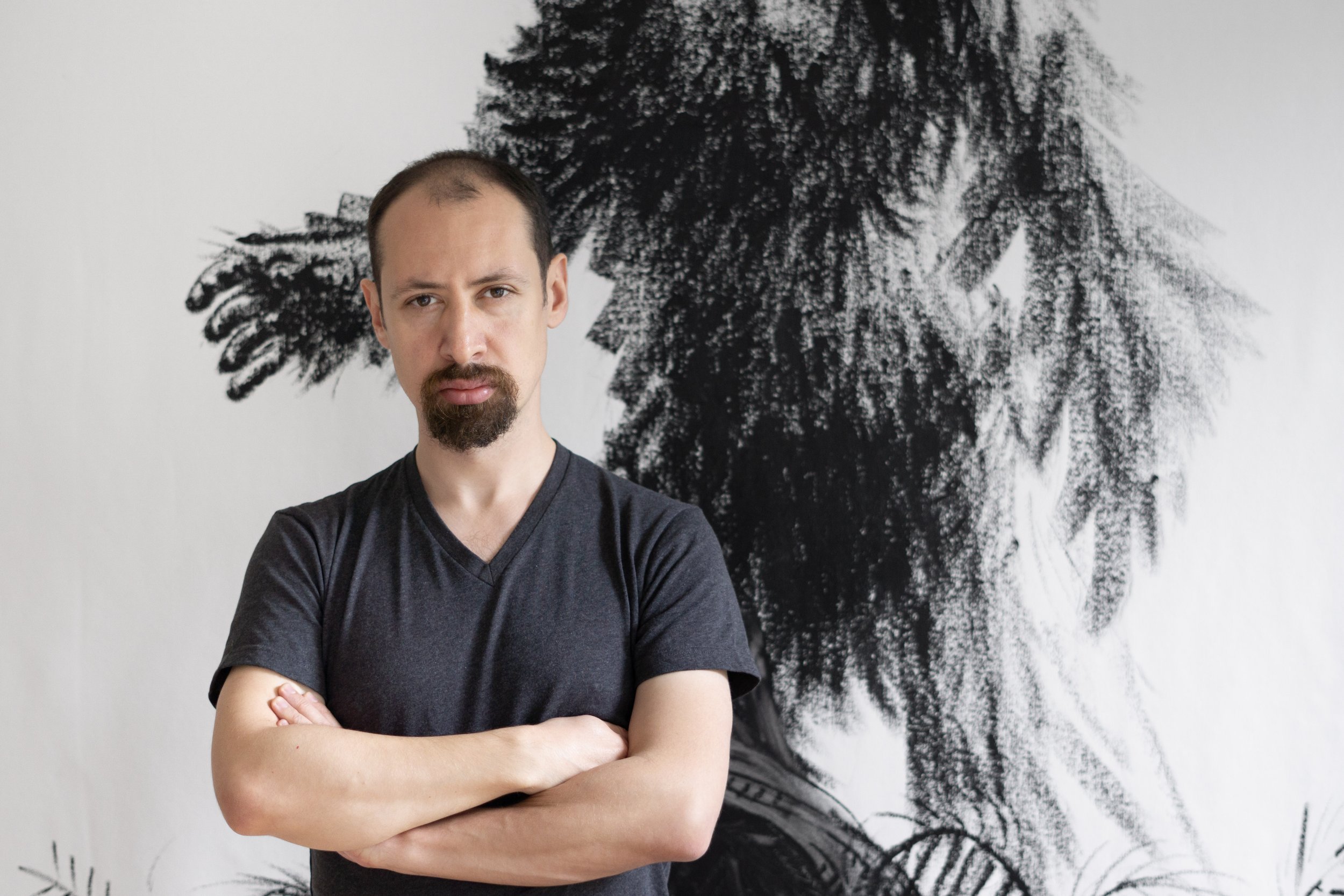
Bio.
Painter Phil Rabovsky (b. 1987) was born in Moscow and grew up in rust belt Upstate New York. He received his BA in art and philosophy from Columbia University in 2009 and his MFA in Art Practice from the School of Visual Arts (SVA) in 2018. He is a member of the faculty at SVA’s MFA in Art Practice, where he leads second and third-year seminars. He has previously been a visiting artist at the school’s BFA program. Phil is a member of Shoestring Press in Brooklyn, where he participated in two-person shows with master printer Lane Sell. His first solo show, Venticento, opened at Van Der Plas Gallery on Manhattan’s Lower East Side in 2018. He has been an artist-in-residence at The Studios at MASS MoCA in North Adams, MA, and a summer workshop participant at the studio of Enrique Martínez Celaya in Los Angeles. His work has been written about in Brooklyn Magazine and Steve Cannon’s A Gathering of the Tribes. In 2019, he launched the podcast Capital A: Unauthorized Opinions on Money, Art, and Everything.
Set adrift by the Soviet apocalypse, Phil has lived on three continents and speaks English, Russian, Hungarian and Spanish. He currently lives in Brooklyn.
Mini statement.
History is important to me. So is the future.
Slightly longer statement.
I was born in Moscow at the end of history. The first four years of my life coincided with the last four of the Soviet Union — that formidable opponent, the alternative to the American Century.
By the time it fell, Jean-Francois Lyotard had already declared the death of grand narratives, those comforting myths that history bends towards justice. Fredric Jameson was writing about the eternal present, “the attempt to think the present historically in an age that has forgotten how to think historically in the first place.” And that ever-optimistic weatherman, Francis Fukuyama, was making sunny predictions: the world had arrived at Western-style capitalism, the final form of human civilization. From now on, there would be no more ideology, no war of ideas. The end of history would be long. It would be boring. But it would be peaceful.
These theories may seem naive to us today, as the twenty-first century darkens. But in a sense, Lyotard, Jameson, Fukuyama and the rest were correct. We did lose something at the end of the twentieth century: a sense that time moves forward, that the future is bigger than the past, that we are part of history. Today, you might stand on some historic battlefield, reading a plaque about retreating redcoats or one of Washington’s headquarters. You look up, and all you see around you is a parking lot. Could it ever have been different?
But while we may no longer feel a part of history, history continues to be written for us. Gunboat diplomacy; reconciliation bills; the AI arms race. These are the tablet and stylus of future history. And the fact that we don’t believe in history anymore simply means that we are not the ones who write it.
Painted on burlap — a sturdy material associated with potato sacks — these paintings translate archival photographs and video stills into the discredited dimensions of history painting. But while the scale is grandiose, the technique is not. Homemade oils smeared by hand onto stretched cloth render the confusion of recent past, eternal present, and elusive future with tools that have changed little since the days of cave painting. These burlap canvases ask — what happens when we do attempt to think historically “in an age that has forgotten how to think historically in the first place?”